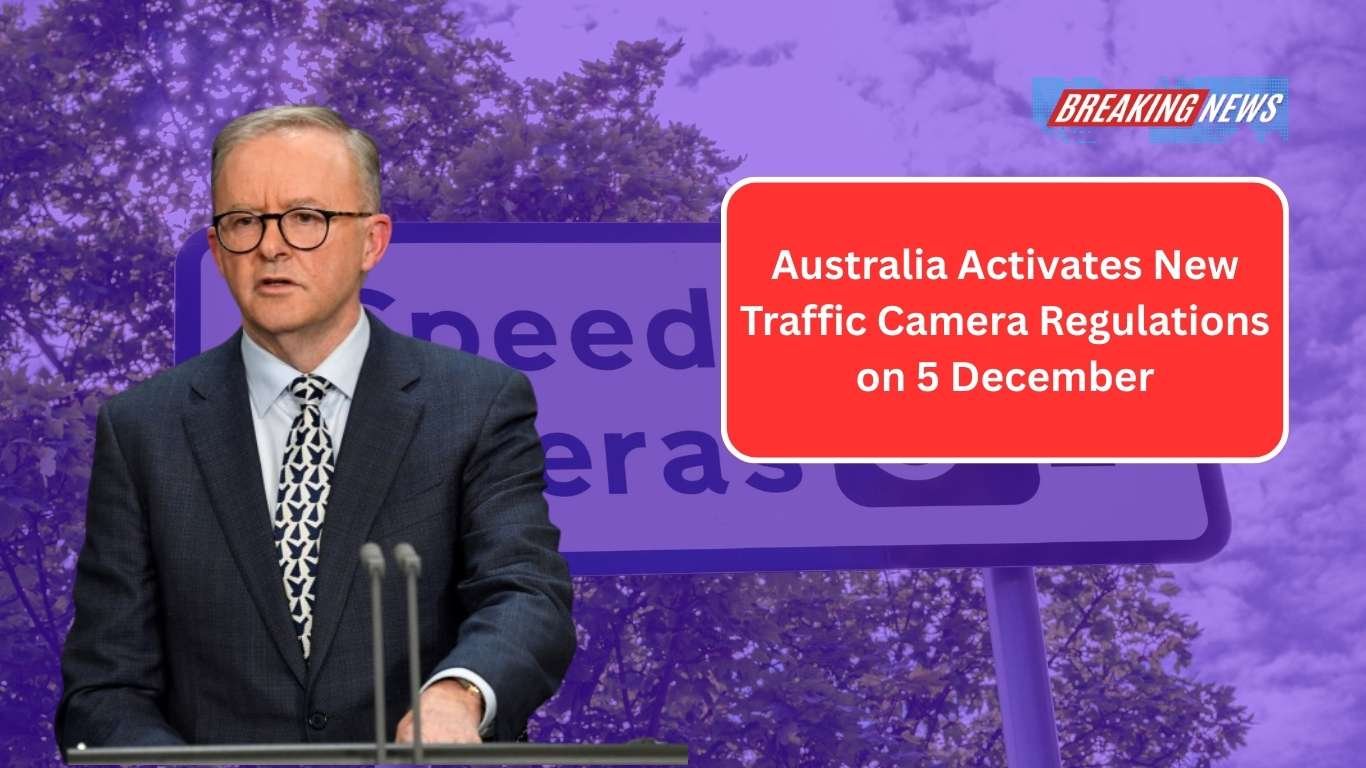
Australia’s road safety framework is entering a new phase this December with the official activation of upgraded traffic camera regulations on 5 December 2025. The reform represents a national step toward faster, more precise, and technology-driven enforcement aimed at reducing high-risk driving behaviours.
Under the new system, enhanced camera networks will immediately detect and penalise a broader range of offences — not just speeding or red-light running. The message from authorities is unambiguous: roads deemed high-risk will carry instant penalties of up to $1,049, and enforcement will be both swifter and stricter than ever before.
A New Era of Automated Enforcement
The December 5 rollout marks one of the most extensive camera upgrades in recent memory. The system integrates high-definition sensors, vehicle-recognition software, and AI-assisted analysis to monitor complex driving patterns in real time.
Unlike older cameras that focused primarily on speeding, the next-generation network will automatically identify behaviours such as dangerous turning, illegal mobile phone use, failure to give way, and unsafe lane changes. These capabilities reflect a major evolution in how Australia approaches traffic surveillance and driver accountability.
The Department of Infrastructure and Transport stated that the objective is not to target minor errors but to significantly reduce fatalities and serious injuries on the nation’s most dangerous roads.
$1,049 Penalties in High-Risk Zones
The backbone of the new enforcement program lies in its targeted approach to high-risk zones — areas identified through historical crash data and frequent safety breaches. These zones include:
- School and childcare boundaries.
- Busy intersections and pedestrian crossings.
- Cyclist-heavy corridors and high-accident stretches.
- Urban areas with dense traffic congestion.
Offences captured by the cameras within these designated zones will attract a $1,049 fine, applied automatically without manual review or delay. According to officials, the immediate nature of the penalty system reinforces the seriousness of driving with care in areas where vulnerability is highest.
For drivers, this means that an ignored road sign, phone distraction, or unsafe manoeuvre could now trigger a four-figure fine simply by being detected within an active high-risk camera network.
Why Authorities Moved Quickly
The early December activation is part of a fast-tracked response to rising crash and injury numbers observed across major metropolitan and suburban roads in 2024 and 2025.
Government data shows that pedestrian and cyclist fatalities increased by more than 12% year-on-year, prompting urgent calls for stronger enforcement mechanisms. Authorities argue that automated technologies can fill enforcement gaps by detecting incidents before they escalate into serious accidents.
With the summer and holiday travel season approaching, officials believe the new system will act as a deterrent when roads are at their busiest. “Immediate accountability,” they noted, “is the cornerstone of prevention.”
Offences That Will Trigger Automated Fines
Each upgraded unit has been tested to detect a wide spectrum of unsafe conduct, with many capable of analysing multiple lanes and directions simultaneously. Offences under the new system include:
- Using a mobile device while driving or at traffic lights.
- Speeding beyond designated limits in high-risk corridors.
- Failing to stop at red lights or pedestrian crossings.
- Tailgating or unsafe lane weaving.
- Ignoring school zone speed reductions.
- Failing to give way to pedestrians or cyclists in shared areas.
In high-risk school and residential zones, repeat offenders may also face immediate licence suspension in addition to monetary fines — a step designed to remove persistent violators from the roads before further harm occurs.
How the System Works
The 2025 enforcement model relies heavily on data connectivity and precision mapping. Each camera is linked to a national enforcement grid that flags violations instantly to the relevant road transport authority. Within seconds, fines are generated digitally and processed toward the vehicle’s registered owner.
Authorities emphasise that accuracy has improved dramatically. Thanks to better image resolution and multi-angle coverage, the likelihood of false readings is drastically reduced. The technology also integrates a “safety verification” filter to ensure legitimate exceptions — such as emergency vehicles — are properly accounted for.
Preparing Drivers for 5 December
Motorists across Australia are being encouraged to review recent updates to traffic rules and signage, particularly around newly classified high-risk areas. Many councils and state transport departments have already begun mapping high-risk camera zones on their official websites, allowing drivers to familiarise themselves with critical locations before December 5.
Awareness will play a crucial role in avoiding fines. Even small lapses — such as checking a message at a red light or creeping past a school crossing — can result in immediate penalties that are automatically enforced.
Technology-Driven Deterrence, Not Revenue
While some motorists have expressed frustration over increasing fines, officials insist that the initiative is focused on safety rather than revenue collection. The integration of artificial intelligence and predictive analytics is meant to prevent accidents rather than punish after the fact.
To enhance transparency, the government has confirmed that collected fine revenue from the new system will be reinvested into road safety infrastructure and public awareness campaigns.
Stronger Protection for Vulnerable Road Users
The expansion of camera coverage provides new protection layers for pedestrians, cyclists, and school children — groups identified as being at higher risk in urban areas. The automatic detection of mobile phone offences near crossings, for example, directly targets one of the leading causes of pedestrian-related collisions.
Officials have also emphasised that visible warning signage will accompany every high-risk camera installation, eliminating concerns about hidden or unmarked enforcement devices.
What Drivers Should Remember
As the activation date approaches, motorists should keep a few critical tips in mind:
- Stay distraction-free: Never use handheld devices, even while stationary in traffic.
- Observe all signage: Pay attention to high-risk zone indicators and reduced speed limits.
- Drive defensively: Anticipate hazards, especially in school and residential areas.
- Verify your route: Check local road authority websites for updated enforcement maps.
The Bigger Picture
Australia’s new camera regulations represent a major leap toward an entirely automated road safety environment, where data and technology act as the first line of defence against crashes. The approach aligns with the national goal of zero road fatalities by 2050, combining real-time enforcement with public accountability.
From 5 December, every motorist will share responsibility for this new chapter in Australia’s driving culture — one defined by vigilance, faster enforcement, and unwavering protection for all who use the roads.